
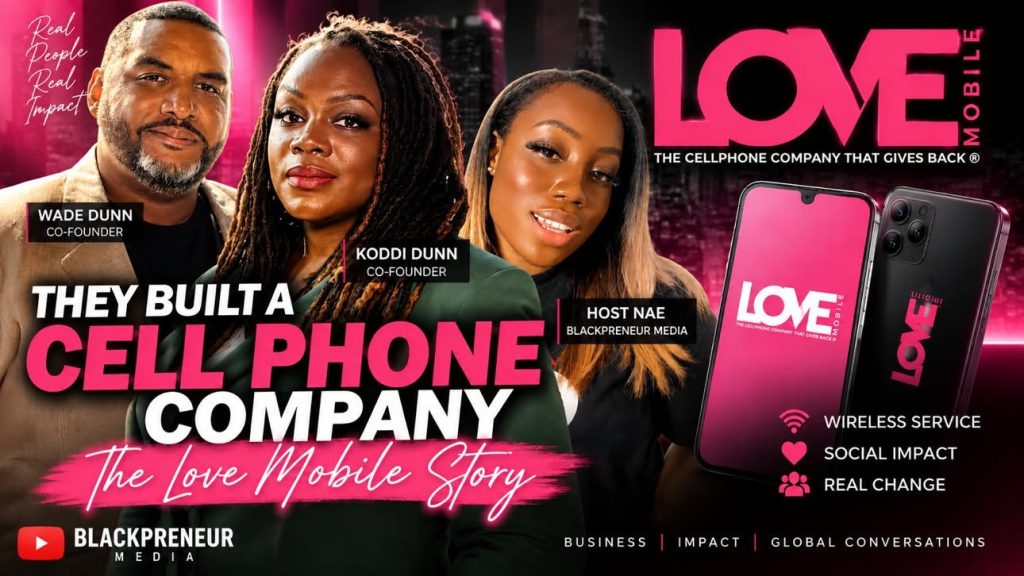
There is a moment in the BLACKpreneur Media interview where Wade Dunn Jr. holds up his phone.
Everyone watching knows what a phone screen says at the top. It says the name of a network, one of three that have divided American wireless for a generation.
Wade turns his phone around.
It says LOVE.
“Can it say that?” he asked. “Can you see that? What it say?”
Love Mobile® Incorporated, the Tulsa, Oklahoma, company he co-founded with his wife, Koddi Dunn, is a licensed prepaid wireless carrier. BLACKpreneur Media, a Black business news outlet with more than 269,000 Instagram followers, sat down with the couple for a wide-ranging interview about how they built it. Every subscriber’s monthly bill funds nonprofits in local communities. The subscriber pays nothing extra and donates nothing.
Love Mobile® is an FCC-filed telecom company, not a storefront reselling somebody else’s service. It carries the same quarterly and monthly compliance obligations, the same taxes and the same fees as any other carrier.
The service runs on all three major U.S. networks, which the company brands Love Pink, Love Blue and Love Red. The All Love plan puts all three on a single device, a configuration Wade Dunn said has not previously existed for consumers.
The technology stack is built in house. Activation is instant over eSIM with no shipped SIM card, and checkout takes about three minutes.
“That is not the industry standard,” he said. “That is the Love Mobile standard.”
Six nonprofit partners and growing, with funding flowing every month from every activated line: Girls Inc. of Greater Atlanta, 1256 Movement, BeHeard Movement, Girl Talk, SWAT Meet and NAMI Tulsa. Each has a dedicated page that locks funding to that organization at signup.
The trademark came before the launch. The Cellphone Company That Gives Back® was registered a full year before the company said anything publicly.
Love Mobile®’s free Grow with Google program produced 566 certifications and 3,334 learning hours in its first year. Service is live in a growing list of states, with more added on a rolling basis.
Plans start at $15 a month. See what’s available in your state.
Koddi Dunn walked out of her office one day after reading headlines she described as scary. Her husband was sitting at the kitchen table.
She said something most parents think and few say aloud.
“Babe, we have failed our kids.”
They had built what people are supposed to build. A house. A blended family of seven children, ages 10 to 29. A safe environment, constructed over 18 years of marriage.
And the children were leaving it. Going to college. Going into a world the Dunns had protected them from rather than improved.
“If all we did was create an environment at home where they feel safe, but we didn’t really go out into this world that they will live in,” she said, “we failed them.”
They already volunteered. They already gave locally. That was the problem. It was episodic. It depended on remembering, on having room in the budget that month, on showing up.
So the question changed shape. Not how do we give back. How could giving back be automatic?
Their research turned up a figure that reframed the problem, and the sector has only confirmed it since. In 2025, 81% of nonprofits struggled to raise enough funds to cover all of their costs, and 36% ended their fiscal year with an operating deficit, according to Independent Sector’s 2025 Health of the U.S. Nonprofit Sector report. An organization that cannot cover its costs cannot run the programs its community depends on.
That sharpened the question again. What if a company funded nonprofits every time someone engaged with it, continuously, rather than through campaigns and annual events?
Then: what does everyone pay every month regardless of circumstance?
Utilities.
“I don’t care what’s going on,” she said. “You gonna pay that water bill, that power bill.”
She was blocked immediately. Nobody was letting her near a power grid.
But everyone has a cell phone.
They spent years on it. Conferences, meetings, rooms where Wade Dunn was often one of the only people of color and Koddi Dunn was frequently the only woman of color at the entire event. They kept going and built relationships one at a time.
Then they let it go. The capital required was enormous. She looked at her bank account and made a decision thousands of founders make quietly every year: good idea, wrong time. They took corporate roles at large companies.
Then she was laid off.
She recovered quickly, landing a better title at higher pay. Then she was laid off again, twice in six months.
“I was sitting in my bedroom one day just broken,” she said. “Brokenhearted, broken spirit, broken dreams.”
What she heard next was two words. Try again.
Her answer was honest. She did not have the try again.
She picked up her phone anyway. An accelerator program was closing applications in 30 minutes. She applied, she admits, almost out of spite. Fine. It’s not going to work.
It worked.
She turned to her husband and asked for one year. A new house and new cars were on the line.
He said: Babe, I’m with you.
Koddi Dunn is careful about this part, because the alternative version is corrosive to anyone listening.
“I won’t gloss it over and make it seem like somebody wrote me a million dollar check,” she said. “Didn’t happen.”
What happened was smaller and harder. Whatever she needed for the next step showed up. Then the next one.
They spent a full year on the trademark alone, protecting the concept before saying anything publicly. That decision came from experience. The Dunns had run a technology company together for 13 years, serving nonprofits and helping them get online with broadcasting. They grew it into a global brand. They never trademarked the concept, and they watched larger companies take what they had built.
“So this time, before we open our mouth, we got our trademark,” Wade Dunn said.
That 13-year business is the part outsiders miss. Love Mobile® is not a first attempt. It is what two experienced operators did with what a previous company taught them.
There is a line the Dunns live by, and it started in a car.
One of their children kept looking out the back window, waiting on a grandmother to come get them.
Koddi Dunn told the child: turn around, no one’s coming.
Wade Dunn explained what it means. As you move further ahead, you look behind to see who is coming to help. It becomes less and less.
“That’s how we live,” he said. They funded their previous venture themselves. They knew they could do it again.
Not despair. Permission.
Wade Dunn’s hardest daily problem is not operational. He named it directly.
“My biggest challenge every day is not that I did it,” he said. “It’s that you won’t believe I did it.”
He has to beat the assumption. The programming, as he put it, that says that isn’t possible for them.
Then he holds up the phone that says LOVE and lets it make the argument.
Every month a Love Mobile® subscriber pays a bill, the company gives back at a hyper-local level across four pillars: education, environment, community services, and pet adoption and care.
The local group helping the unhoused. The local group helping people leaving incarceration. The local group feeding the hungry.
The subscriber does nothing extra. No donation, no round up, no opt in. Plans start at $15 a month.
“Out of my margin,” Koddi Dunn said. “I’m not asking you to do it. I’m doing it. Out of my margin, I’m going to support those that are supporting us by doing the work that matters.”
Her husband closed the loop on the remaining objections. The service is there. The value is there. The LIFE Perks benefits covering hotels, food, shopping and education are there. The give back is there.
“We’ve taken away every excuse,” he said. “Now, after all of that, you still won’t come? That ain’t on us.”
Start a line in about three minutes at GetLOVEMobile.com
The last stretch of the interview leaves the business behind.
Wade Dunn talks about dreams as a future self’s memories, a line he credits to a speaker he heard. A memory is something that already happened. By that logic a dream is not a wish. It is an event on a timeline.
And fear, he argues, is not trying to make you sad. It is trying to stop the event.
He gives the audience an assignment. Get a pen. Get a notebook. Put the phone down. Sit still. Write it down, all of it, and do not pre-qualify it, diminish it or dismiss it.
“Because even the biggest thing you’re thinking, you still thinking too low.”
That passage runs several minutes and draws on his own convictions. It is worth hearing in his voice rather than in summary. It begins around the 26-minute mark of the full episode.
The story ends where it started.
Someone recently reminded Koddi Dunn of walking into her office in 2019. On the whiteboard in the corner were two words.
Love Mobile.
She had asked what it was. Koddi told her it was an idea for a cell phone company that gives back to nonprofits when people pay their bill.
“It was just a word on a board,” she said.
It is now trademarks, contracts, funding, relationships, FCC filings, three networks, and six nonprofit partners and growing, with funding flowing every month from every activated line.
Same two words.
Before signing off, host Nae did something interviewers rarely do. She stopped interviewing and started organizing.
She committed her own audience to a goal of 1,000 Love Mobile® subscribers by the end of the year, promoted across her Instagram, TikTok and Facebook channels, with a second episode already planned.
“It’s bigger than us,” she said. “We either want to make things happen with each other or we not.”
At 1,000 supporters, a single nonprofit partner can receive up to $120,000 a year, and it recurs every year those accounts stay open.
That is what the number means. Not a marketing goal. A funded organization.
Watch the full conversation on BLACKpreneur Media, and start your line at GetLOVEMobile.com. Nonprofits can apply at nonprofit.getlovemobile.com.
BLACKpreneur® is a Black business news outlet publishing under the mission “Rebuilding Black Wall Street on a global scale.” The publication reaches more than 269,000 followers on Instagram, where it has posted more than 11,500 times, and produces long-form founder interviews through BLACKpreneur Magazine and its YouTube channel. “They Built A Cell Phone Company: The Love Mobile® Story” was hosted by Nae.
Love Mobile® Incorporated is a prepaid wireless company headquartered in Tulsa, Oklahoma. Plans start at $15 a month. Every line funds nonprofits in local communities every month, automatically, for the life of the account.
Copyright © 2026 Love Mobile Incorporated.
All rights reserved.